Loading application...
This may take a few seconds
Discover the real odds bookmakers hide—and how to find your edge. Remove vig, calculate fair odds, and build a mathematically sound betting strategy.
Overround visualiser · Soccer 3-way market
104.37% ⚠️Bookmaker odds — vig included
True probability is the actual, objective likelihood of an outcome occurring—completely stripped of bookmaker profit margins. It always sits somewhere between 0 and 1 (or 0% and 100%), representing the "fair" chance of an event before the house takes its cut.
Think of a coin flip: the true probability of heads is exactly 50%, and tails is exactly 50%. The two sum to 100%—a perfectly balanced market. But if a bookmaker were offering odds on the coin flip, they might price both sides at odds implying 52% each (totalling 104%), keeping that extra 4% as profit regardless of the outcome.
Finding true probability means removing that 4%. It's the difference between what the bookmaker wants you to believe and what the mathematics actually says.
The Probability Spectrum
| Concept | What It Means | American Odds Example | Decimal Odds Example |
|---|---|---|---|
| True Probability | The real, fair chance of an outcome — no margin included | Coin flip: 50% | Coin flip: 50% → fair odds 2.00 |
| Implied Probability | Probability implied by bookmaker odds — always inflated | –110 → 52.38% | 1.909 → 52.38% (1 ÷ 1.909) |
| Overround | Sum of all implied probabilities — the bookmaker's profit layer | –110 / –110 game → 104.76% total | 1.909 / 1.909 → 104.76% total |
| Vig (Juice) | The percentage above 100% — the bookmaker's guaranteed cut | 104.76% − 100% = 4.76% vig | Same: 4.76% regardless of format |
| Fair Odds | What the odds would be with zero bookmaker margin | –110 → fair odds: +100 (even money) | 1.909 → fair odds: 2.00 |
| Value Bet | A bet where your estimated true probability exceeds implied probability | You estimate 55%, book prices –110 (52.38%) → +EV | Your model: 55%. Book: 1.909 (52.38%) → bet has edge |
The formula is disarmingly simple. True probability is just the implied probability divided by the total implied probability across all outcomes. The hard part is understanding why that division works—and knowing when to use a more sophisticated method.
Core Formula
NFL Regular Season · Patriots vs Bills · DraftKings
Bookmaker Odds:
  Patriots  –110  →  Decimal: 1.909
  Bills     –110  →  Decimal: 1.909

Step 1: Implied Probabilities
  Patriots: 1 ÷ 1.909 = 52.38%
  Bills:    1 ÷ 1.909 = 52.38%

Step 2: Overround
  Total:    52.38% + 52.38% = 104.76%
  Vig:      4.76%

Step 3: True Probabilities (proportional method)
  Patriots: 52.38% ÷ 104.76% = 50.00%
  Bills:    52.38% ÷ 104.76% = 50.00%

Result: Fair odds are 2.00 (even money), not 1.909
Bookmaker (with vig)
True Probability (vig removed)
The proportional method—dividing by the total—is the most common and works well when outcomes are roughly symmetrical. For more extreme odds discrepancies, specialists use:
Default. Equal vig removal across all outcomes. Best for balanced markets.
Better when one outcome has very short odds (e.g., 1.10 vs 8.00).
Subtracts vig equally from each probability. Less precise but fast.
Scales probabilities by a constant factor. Alternative to proportional.
Bookmakers don't hide true probability through deception—they do it through structural design. Every market is built so that the sum of implied probabilities exceeds 100%. This guaranteed excess is their profit, collected regardless of which team wins.
Understanding how overround works—and how much you're paying per bet—is the first step toward beating the house.
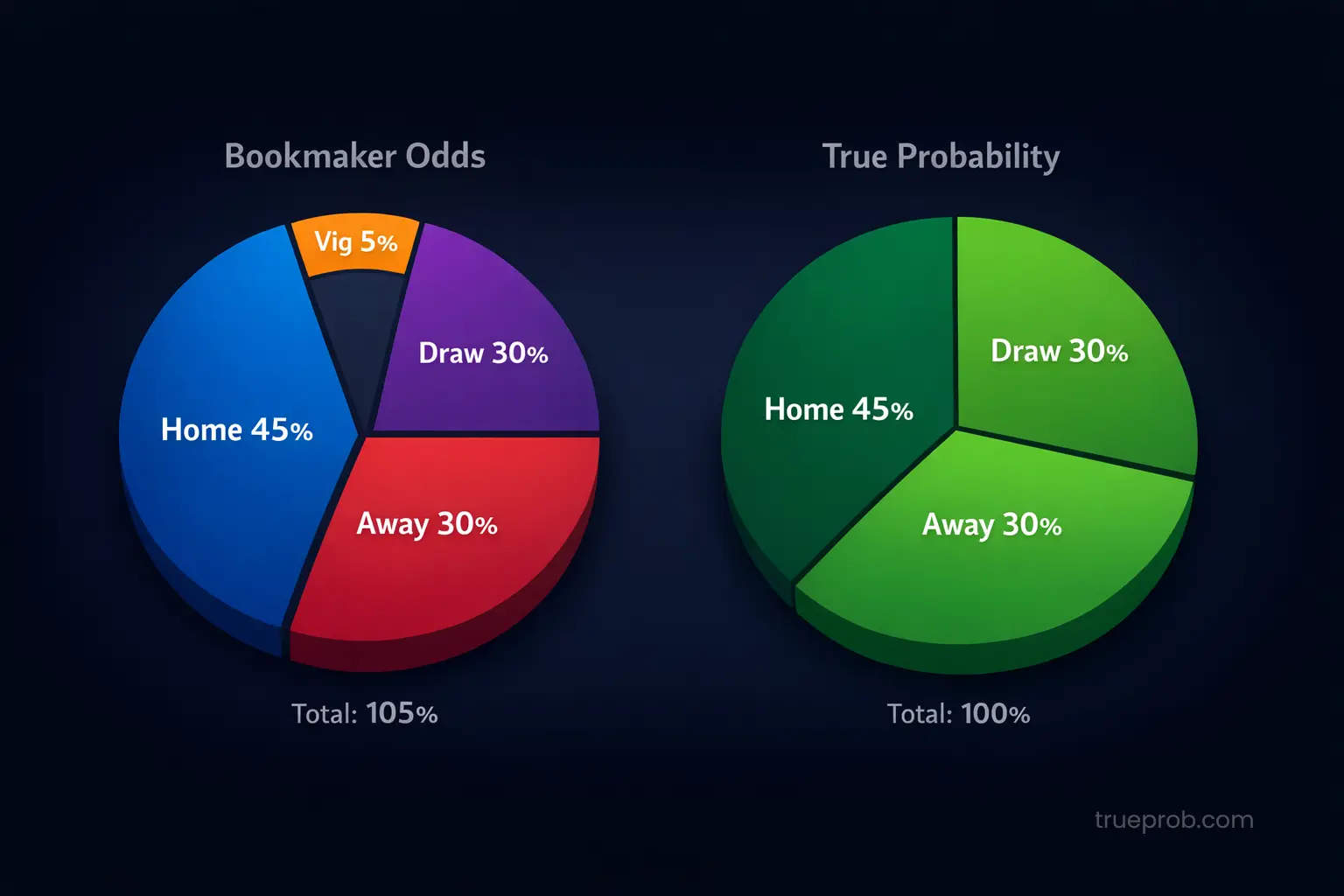
IMAGE: Two pie charts — Bookmaker (105%) vs True Probability (100%)
Prompt: 3-way soccer market, amber vig slice vs clean green true-probability split, dark bg
| Sport / Market | Avg Overround | Typical Vig |
|---|---|---|
| NFL Moneyline | 104–105% | 4–5% |
| NBA Spreads | 104.5–106% | 4.5–6% |
| Soccer 3-Way | 105–108% | 5–8% |
| Tennis | 104–106% | 4–6% |
| Niche Sports | 108–115% | 8–15% |
| Futures Markets | 115–130% | 15–30% |
| Prop Bets | 110–120% | 10–20% |
Why Does Overround Vary So Much?
Lower overround in liquid markets (NFL, major tennis) because sharp bettors force bookmakers to price efficiently. Higher overround in niche markets because bookmakers carry more risk and face less competition on pricing.
Futures markets carry the highest vig (15–30%) because they're open for months, require the bookmaker to hold liability for long periods, and are hard for bettors to track efficiently.
Bookmaker Odds Offered
Chiefs:  –120  (1.833 decimal)
49ers:   +100  (2.00  decimal)

Implied:
  Chiefs:  54.55%
  49ers:   50.00%
  Total:   104.55%  ← 4.55% vig
After Vig Removal
True Probabilities:
  Chiefs:  52.17%
  49ers:   47.83%

Fair Odds:
  Chiefs:  1.92 (vs 1.833 offered)
  49ers:   2.09 (vs 2.00 offered)

$100 bettor on Chiefs:
  EV cost of vig: –$9.20
Every bettor on this market paid ~$4.55 in expected value per $100 wagered before the coin was even tossed. Over 100 bets at this level, that's $455 lost to vig alone—before any game outcomes are factored in.
The Setup: Arsenal vs Liverpool, Premier League. The same match priced on two bookmakers — Bet365 and 1xBet — shows how dramatically overround varies even on the same event.
Bet365
Arsenal (Home): 2.20  → 45.45%
Draw:          3.40  → 29.41%
Liverpool:     3.25  → 30.77%

Total:         105.63%
Vig:           5.63%

True Probabilities:
Arsenal:  43.03%  (fair: 2.324)
Draw:     27.84%  (fair: 3.592)
Liverpool:29.13%  (fair: 3.433)
1xBet
Arsenal (Home): 2.29  → 43.67%
Draw:          3.52  → 28.41%
Liverpool:     3.36  → 29.76%

Total:         101.84%
Vig:           1.84%

True Probabilities:
Arsenal:  42.88%  (fair: 2.332)
Draw:     27.90%  (fair: 3.584)
Liverpool:29.22%  (fair: 3.422)
The Insight: Both books broadly agree on the true probabilities (~43 / 28 / 29). But Bet365 charges 5.63% vig vs 1xBet's 1.84%. Over 100 bets at £100 stake, Bet365 costs ~£379 more in vig. Same game, same true probability — 3× the cost.
The Setup: Bucks vs Knicks, NBA regular season. Most bettors default to the point spread (-110 both sides). But the moneyline on the same game tells a different — and cheaper — story.
Point Spread (–7)
Bucks –7:    –110  →  1.909  →  52.38%
Knicks +7:   –110  →  1.909  →  52.38%

Total:        104.76%
Vig:          4.76%

True Prob (each side): 50.00%
Fair decimal odds:     2.000
Moneyline (same game)
Bucks ML:   –320  →  1.313  →  76.19%
Knicks ML:  +260  →  3.600  →  27.78%

Total:        103.97%
Vig:          3.97%

True Prob:
  Bucks:   73.29%  (fair: 1.365)
  Knicks:  26.71%  (fair: 3.744)
The Insight: The point spread carries 4.76% vig. The moneyline on the same game carries only 3.97% vig — 0.79% cheaper per bet. For a favourite-heavy bettor, always check whether the moneyline or the spread offers the lower overround. They won't always agree on who's offering better value.
The Setup: Two tennis markets on the same day — a US Open quarter-final and an ATP Challenger R2. Same sport, same bet type (match winner), wildly different overround.
US Open QF (Betfair / Unibet)
Medvedev: 1.57  →  63.69%
Zverev:   2.45  →  40.82%

Total:    104.51%
Vig:      4.51%

True Prob:
  Medvedev: 60.94%  (fair: 1.641)
  Zverev:   39.06%  (fair: 2.560)
ATP Challenger R2 (1xBet)
Gomez:    1.65  →  60.61%
Tabilo:   2.20  →  45.45%

Total:    106.06%
Vig:      6.06%

True Prob:
  Gomez:   57.15%  (fair: 1.750)
  Tabilo:  42.85%  (fair: 2.334)
The Insight: The Grand Slam carries 4.51% vig. The Challenger carries 6.06% — 34% more expensive. This isn't the bookmaker being greedy; it's the direct cost of lower liquidity. Less money traded means the bookmaker shoulders more risk and prices accordingly.
The Setup: India vs Australia, ODI World Cup. Two bets available: match winner (main market) and top team batsman (prop market). The vig gap between them is enormous.
Match Winner (Betway / 10Cric)
India:     1.72  →  58.14%
Australia: 2.20  →  45.45%

Total:     103.59%
Vig:       3.59%

True Prob:
  India:     56.13%  (fair: 1.782)
  Australia: 43.87%  (fair: 2.280)
Top India Batsman (prop, Betway)
Kohli:    3.00  →  33.33%
Rohit:    3.50  →  28.57%
Gill:     4.50  →  22.22%
Iyer:     5.00  →  20.00%
Others:   6.00  →  16.67%

Total:    120.79%
Vig:      20.79%
The Insight: The match winner carries just 3.59% vig — one of the lowest in cricket. The top batsman prop on the same match carries 20.79% vig. To profit on the prop long-term, your model must be more than 20% better than the bookmaker's. The main market requires only a 3.6% edge.
Follow this four-step process for any market, in any odds format. We'll use an NBA game as the example.
Given: Lakers +150 (2.50 decimal), Celtics –180 (1.556 decimal)
Lakers (+150 / 2.50):
  Implied = 1 ÷ 2.50 = 0.400 = 40.0%

Celtics (–180 / 1.556):
Implied = 1 ÷ 1.556 = 0.643 = 64.3%Total = 40.0% + 64.3% = 104.3%
Overround = 104.3%
Vig = 4.3%Lakers True Probability:
40.0% ÷ 104.3% = 38.35%
Celtics True Probability:
64.3% ÷ 104.3% = 61.65%
Check: 38.35% + 61.65% = 100.00% ✓Lakers Fair Odds:
1 ÷ 0.3835 = 2.608 decimal (+160.8 American)
Offered: 2.50 (+150) → NEGATIVE EV
Celtics Fair Odds:
1 ÷ 0.6165 = 1.622 decimal (–160.8 American)
Offered: 1.556 (–180) → NEGATIVE EVBoth bets have negative expected value
For multi-outcome markets and all odds formats, use our full calculator →
Understanding the mathematics is one thing—applying it to live markets quickly is another. We've built nine free calculators covering every aspect of true probability, all available without signup.
Enter any market odds—2-way, 3-way, or N-way—and get instant true probabilities, fair odds in all formats, and vig breakdown. No signup. Free forever.
Launch Calculator →Markets aren't always efficient. Here are three real examples where applying true probability analysis revealed significant value—and the principles behind them.
The Setup: After the Conference Championships, 80% of bets landed on the San Francisco 49ers. Bookmakers moved the line to protect themselves, inadvertently creating value on the Kansas City Chiefs.
Closing Moneyline Odds
49ers:  –145  (1.690)
Chiefs: +125  (2.250)
Overround: 103.62%
True Probability (vig removed)
49ers:  57.13%
Chiefs: 42.87%

Historical: Chiefs big game ~50/50
The Insight: Historical data on championship underdogs with elite quarterbacks and high-stakes game experience showed a much closer to 50/50 true probability. The market's 57/43 split was a function of public betting, not objective probability assessment.
Result: Chiefs won in overtime. Chiefs +125 ML was an outstanding value bet once the vig was removed and historical base rates applied.
The Setup: Leicester City were offered at 5000/1 to win the Premier League before the season. This implies a true probability of just 0.02%.
Bookmaker Assessment
Odds:   5000/1
Implied: 0.02%
Fair odds: 5000/1 ← ???
Revised True Probability
Historical base: ~2%
Structural factors: ↑↑
Revised estimate: 1–2%
Fair odds: 50/1–100/1
The Mispricing: At 5000/1, the implied probability was 0.02%. Even using a conservative 1% estimate (accounting for their new analytics-led ownership, elite counter-attacking system, and squad fitness), the fair odds were 100/1. The market was off by 50×.
Result: Leicester won the league. Anyone who correctly assessed the structural change in the club's probability—even at 1%—recognised the value at 5000/1 odds.
The Setup: Public bettors systematically hammer rested favourites against teams playing their second game in two nights, believing fatigue creates a simple edge.
Historical data (2020–2024):
  Home (rested) vs Road (B2B): 58% ATS*
  Road underdogs on B2B: 52.3% ATS

*Against the Spread
The Insight: Bookmakers already bake in fatigue adjustments. Because the public overweights the narrative, they move lines further than the data justifies—creating value on the "fatigued" underdog.
Example: Bucks vs Pacers (Pacers on B2B)
Bucks: –8.5 (–110)
Offered Pacers ATS probability: 47.6%
True probability (after vig):   45.7%
Model-estimated true prob:      53.0%

Edge: +5.4% on Pacers ATS
The Principle: Obvious narrative factors—fatigue, short rest, travel—are almost always priced in. True value comes from second-order effects: which team has better depth, which system suffers less from fatigue, which coach manages minutes effectively.
Overreactions to Recent Form
Recency bias inflates recently winning teams, deflates losing streaks beyond statistical significance.
Playoff Underdogs with Elite QBs
Small sample bias: the market underrates teams with proven big-game quarterbacks.
Low-Scoring Soccer Games
Standard Poisson underestimates 0-0 draw probability by 20–40% in defensive match-ups.
Live Betting After Big Plays
Emotional overreaction to touchdowns and goals creates temporary mispricing in live markets.
Props on Star Players
Public overvalues name recognition—high-profile players attract money regardless of matchup quality.
This guide is just the starting point. Dive deeper into specific aspects of true probability with our full library of guides, models, and calculators—organised by category.
True probability is the foundation of long-term betting profitability. By learning to remove bookmaker vig, calculate fair odds, identify genuine value bets, and apply advanced models like Poisson and Bayesian inference, you gain an edge that compounds over thousands of bets.
Even a 2–3% edge, applied consistently to a $10,000 bankroll over 500 bets, generates $1,000–$1,500 in expected profit. That's the arithmetic of true probability done right.
Your Next Steps
Ready to Find True Odds?
Remove vig, find value, bet smarter. Free, no signup required.
Launch Calculator →